
Manal Saleh
Riyadh,
Saudi Arabia, 14 July 2026:
In April 2026, four astronauts aboard NASA's Orion spacecraft launched on the
Artemis II mission—the first crewed voyage to the Moon since Apollo 17 in 1972.
An estimated 25 million people watched the launch live on NASA+, YouTube, and
Prime Video, and days later, millions more tuned in to see something no one had
ever witnessed: 4K video of astronauts rounding the Moon, transmitted to Earth
by laser.
You
may have watched the launch, but what you didn't see was everything behind it:
the years of engineering work, the cloud-based computing that charted the
flight path, and a network connection built in weeks between NASA and Australia
to deliver 4K video to 25 million viewers.
Computing
a path to the Moon
Trajectory
design for a crewed lunar mission isn't a single calculation. The Orion flight
sciences team at NASA's Johnson Space Center runs tens of thousands of
simulations across nominal and off-nominal (mission control speak for normal
and abnormal) scenarios, generating two to five terabytes of data for each
potential launch window.
The
computing platform behind those simulations runs in AWS GovCloud (US)—a secure,
government-certified cloud environment required for handling Artemis flight
data. In the first 48 hours after launch, the system calculated flight path
adjustments in near real-time, processing thousands of compute hours to
retarget and optimize the trajectory as conditions changed.
Booz
Allen Hamilton built the system using a technique called cloud bursting: when
NASA's analysts needed more computing power, they could scale into hundreds of
additional Intel-based cloud instances on demand. No waiting in line.
On-premises systems are a shared resource—many missions compete for time on
them. For Artemis II, the cloud meant the team could run simulations whenever
they needed to, not whenever a slot opened up.
Laser
light for a global network: Connecting the Moon to Earth
Artemis
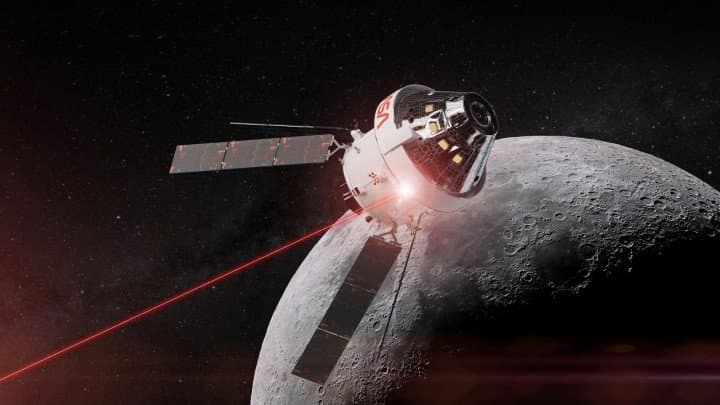
II carried a piece of technology NASA had been developing for more than two
decades: the Orion Artemis II Optical Communications System, or O2O. O2O is a
laser-based terminal capable of transmitting data from the Orion spacecraft at
up to 260 megabits per second, fast enough for real-time 4K video.
One
of O2O's partner ground terminals sits at the Australian National University's
Mount Stromlo Observatory near Canberra: a critical receiving station for laser
downlinks during the portions of Orion's trajectory visible from the Southern
Hemisphere. To complete the link between Mount Stromlo and NASA's White Sands
Complex in New Mexico, where mission operations would process and distribute
the video, NASA needed a high-performance network path that could be stood up
quickly and operate reliably at scale.
NASA
chose AWS for the terrestrial leg of the connection. The team linked Mount
Stromlo to a network node in Australia and routed the signal across a global
backbone to White Sands, New Mexico—covering roughly 15,000 kilometers in
milliseconds. AWS, NASA, and ANU partnered and stood up the connection in a
matter of weeks, for the cost of a laptop. From there, it went around the
world.
Bringing
250 million people closer to the Moon
NASA+,
NASA's official streaming platform, served as a hub for all Artemis II
coverage. The platform runs on AWS Elemental services, with MediaLive handling
live video encoding and MediaConnect providing reliable transport to
distribution partners including YouTube, and Prime Video, which was onboarded
as a channel partner during the 2025 migration.
The
Artemis II stream was the proving ground for NASA. For the upcoming Artemis IV
lunar landing—the first time humans will set foot on the Moon since 1972—the
agency is planning for an estimated 250 million viewers.
For
Artemis II, NASA+ produced live broadcasts of launch, lunar flyby, and
splashdown—with a continuous feed running between them. The production spanned
four NASA centers, interconnected through a cloud-based workflow. Prime Video
carried the feed under NASA's mandate to reach the widest possible
audience—every feed distributed free of charge.
The
4K footage traveled by laser from Orion as it passed the Moon all the way to
Australia, crossed the AWS backbone to NASA, was encoded through AWS Elemental,
and reached viewers on their phones and televisions—an end-to-end chain
spanning over a quarter million miles, connecting viewers to the farthest
humans ever to travel from Earth.
A
moonshot, built on invisible infrastructure
Four
humans circled the Moon for the first time in over fifty years and for a few
hours, the world remembered what we're capable of when we work together. That
moment belonged to NASA, to the crew, and to everyone who looked up. What made
it possible was mostly invisible: years of engineering, a laser link across a
quarter million miles, and a network stitched together in weeks—all just for
the cost of a laptop.
END
About Amazon Web Services
Since 2006, Amazon Web
Services has been the world’s most comprehensive and broadly adopted
cloud. AWS has been
continually expanding its services to support virtually any workload, and it
now has more than 240 fully featured services for compute, storage, databases,
networking, analytics, machine learning and artificial intelligence (AI),
Internet of Things (IoT), mobile, security, hybrid, media, and application
development, deployment, and management from 105 Availability Zones within 33
geographic regions, with announced plans for 18 more Availability Zones and six
more AWS Regions
in Malaysia, Mexico, New Zealand, the Kingdom of Saudi Arabia, Thailand, and
the AWS European
Sovereign Cloud. Millions of customers—including the fastest-growing startups,
largest enterprises, and leading government agencies—trust AWS to power their
infrastructure, become more agile, and lower costs. To learn more about AWS, visit aws.amazon.com.

-large.jpg)




-large.jpg)
-large.jpg)
كن أول من يشارك رأيه
ابدأ النقاش حول هذه القصة.