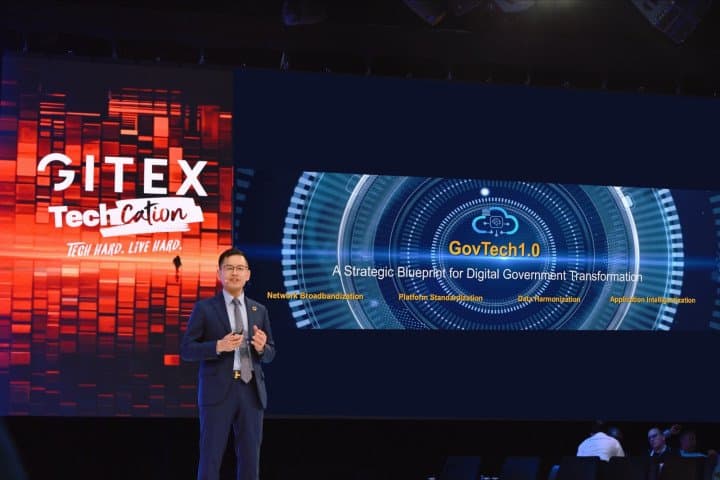
Huawei Launches GovTech1.0 Framework to Drive Digital and Intelligent Government Transformation

Rashad Iskandrni
[Dubai, UAE, October 14, 2025] During
GITEX GLOBAL 2025, Allen Tang, President of Huawei's Middle East & Central
Asia ICT Marketing & Solution Sales Department, launched the GovTech1.0 Framework,
a strategic blueprint for governments' digital and intelligent transformation. In
his keynote speech, Tang shared Huawei's latest insights and practices for helping
governments go digital and intelligent, and explained how the GovTech1.0 Framework
and related solutions could accelerate this process.
Tang also introduced Huawei's Global
Digitalization & Intelligence Index (GDII), and emphasized that the
widespread application of innovative technologies has been at the heart of every
leap forward in socio-economic development. The GDII is designed to measure and
track the development of digital economies worldwide by evaluating indicators
such as data usage and infrastructure. Jointly developed by Huawei, IDC, and
GSMA Intelligence, the index compares the performance of 90 countries across seven
pillars: data creation, data transfer, data processing and storage, data
application, digital energy, policy, and talent and ecosystem. This provides a valuable
reference for formulating better strategies and making smarter investments. Today,
AI is being rapidly deployed in all areas, giving rise to new business models
and formats, and stimulating the systemic transformation of economic patterns
and social governance models. Against this background, all countries must
advance their digital and intelligent transformation to seize opportunities and
enhance competitiveness.
To date, more than 170 countries and
regions around the world have issued digital strategies, as part of their
top-level design for national development. According to the UN's E-Government
Development Index (EGDI), numerous governments in the Middle East and Central
Asia are now on the fast track to digitalization. Pioneers like Saudi Arabia,
the UAE, and Kazakhstan have all achieved major breakthroughs in service
efficiency and data governance capabilities through continual digital reforms.
These countries have now emerged as regional leaders in the development of core
frameworks for intelligent governments.
The GovTech1.0 Framework is built upon
deep insights into the development patterns of digital and intelligent governments,
as well as thorough research on transformation practices in the Middle East and
Central Asia. This framework focuses on four core concepts: Network
broadbandization, Platform standardization, Data
harmonization, and Application intelligentization. It provides a
comprehensive blueprint for intelligent governance in four dimensions:
infrastructure, platform architecture, data value, and application efficiency.

GovTech1.0 builds on Huawei’s strengths
in connectivity, cloud, and computing. It integrates smart networks, unified
platforms, and advanced AI to power digital portals, governance, public
services, and emergency response.
•
Network
broadbandization :Broadband
network deployment is the cornerstone of any government's digital and
intelligent transformation. Governments currently have several key demands,
including digital offices, diverse urban access, and private networks for government
services. This has created an urgent need to build high-bandwidth,
multi-service, and integrated e-government private networks to lay a solid
foundation for the subsequent implementation of intelligent applications.
•
Platform
standardization :Supported
by e-government private networks, government governance platforms must become
increasingly integrated with a focus on building a unified cloud infrastructure
that is flexible, reliable, and secure. Based on such infrastructure,
governments should centrally manage and dynamically allocate computational
resources to address their key pain points, such as dispersed resources, inefficient
resource scheduling, weak security assurance, insufficient cloud resource
elasticity, and complex O&M systems.
•
Data harmonization : Tang advocated for data integration
to address core challenges in government digital and intelligent
transformation, such as difficult data access, inconsistent data quality, high
barriers to cross-departmental sharing, and significant pressure when managing
security risks. Building a unified data integration platform can eliminate data
flow bottlenecks, enhance data governance quality, and ultimately achieve the
secure circulation of high-quality data and unleash its true value.
•
Application
intelligentization :Government
applications often encounter challenges such as long development cycles,
limited AI integration, and difficulties in sustaining long-term innovation. To
address these, Tang proposed the creation of one-stop application and AI
development tools to accelerate the rollout of on-premise intelligent
applications. According to this approach, Huawei has developed two core support
systems—DevCloud and ModelArts—based on its own cloud platform. These provide
governments with end-to-end support from development to implementation, improving
application development efficiency and facilitating AI integration.
Global
digital and intelligent transformation is rapidly reshaping the development
landscape, with technology acting as a key driver of national advances. Huawei
is committed to using its strengths in technology and solutions to provide
comprehensive support for government digital and intelligent transformation alongside
its global customers and ecosystem partners, and thus shape the future of intelligent
governance.
————
For
more information, please visit: https://e.huawei.com/ae/events/ae/gitex/2025
About Huawei
Founded in 1987, Huawei is a leading global
provider of information and communications technology (ICT) infrastructure and
smart devices. We have more than 208,000 employees, and we operate in more than
170 countries and regions, serving more than three billion people around the
world.
Our
Vision and mission is to bring digital to every person, home and organization
for a fully connected, intelligent world. To this end, we will drive ubiquitous
connectivity and promote equal access to networks; bring cloud and artificial
intelligence to all four corners of the earth to provide superior computing
power where you need it, when you need it; build digital platforms to help all
industries and organizations become more agile, efficient, and dynamic;
redefine user experience with AI, making it more personalized for people in all
aspects of their life, whether they're at home, in the office, or on the go.
For more information,
please visit Huawei online at:
www.huawei.com
or follow us on:
http://www.linkedin.com/company/Huawei
http://www.x.com/Huawei
http://www.facebook.com/Huawei
http://www.youtube.com/Huawei
مواضيع ذات صلة

HP Delivers Measurable Progress in Saudi Arabia Across AI Innovation, Local Manufacturing and Future Skills
منذ 5 ساعات . News

Petromin Energy and Lulu Sign Strategic Partnership to develop 10 SWFT convenience stores in Saudi Arabia
منذ 5 ساعات . News
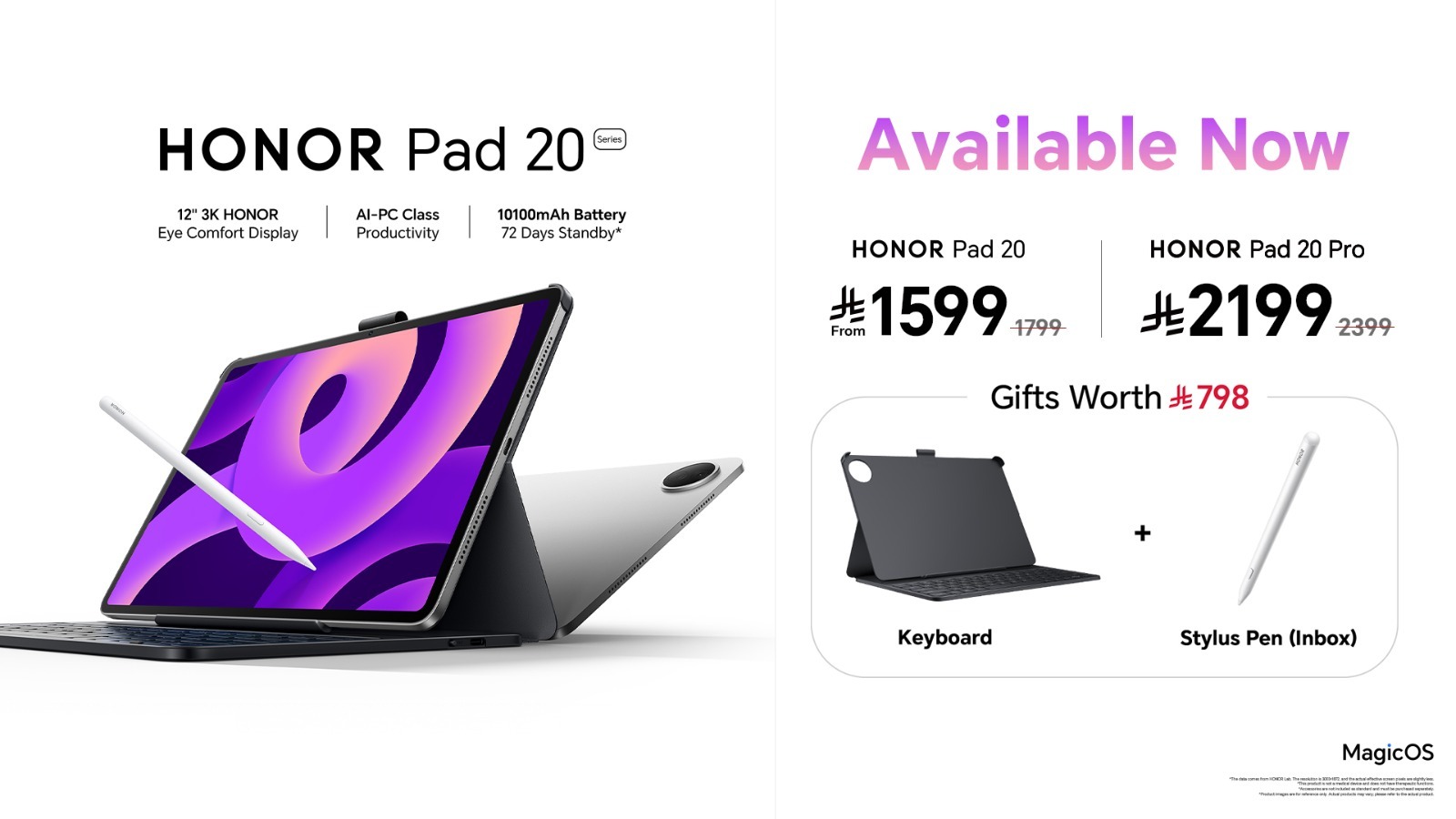
HONOR Pad 20 Brings Desktop-Class Productivity and a Paper-Like Display to a New All-Day Tablet
منذ 5 ساعات . News

LG ELECTRONICS REAFFIRMS COMMITMENT TO LOCAL MANUFACTURING: 2026 RESIDENTIAL AIR CONDITIONER LINEUP PROUDLY FEATURES “SAUDI MADE” DISTINCTION
منذ 6 ساعات . News

Ten Days, Three Icons, One Bold Bet: Dhahran Mall Rewrites the Rules of Retail Entertainment
منذ 6 ساعات . News

Armah Sports Debuts on Saudi Main Market, Targets 50-Club Network by 2030
منذ 7 ساعات . News

# Disty Holdings Is Reimagining Procurement with AI
منذ يوم . News

Nutanix Showcases "One Platform, One Experience" at LEAP Saudi Arabia 2026, Highlighting AI, Hybrid Multicloud and Cloud-Native Innovation
منذ يوم . News
.jpeg)
Garmin Opens First Riyadh Store and Launches fēnix 9 Series in Saudi Arabia
منذ يومين . News