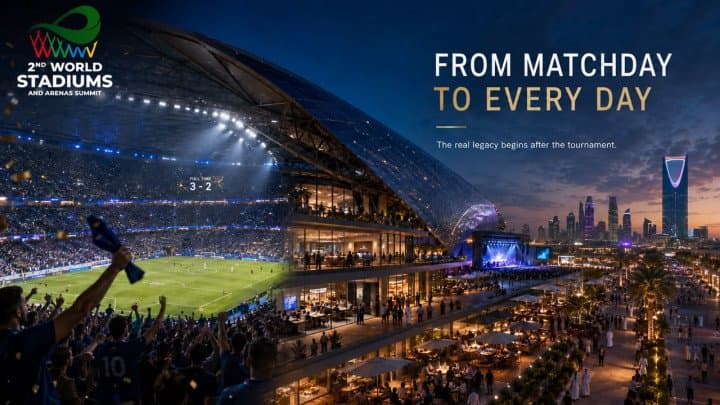
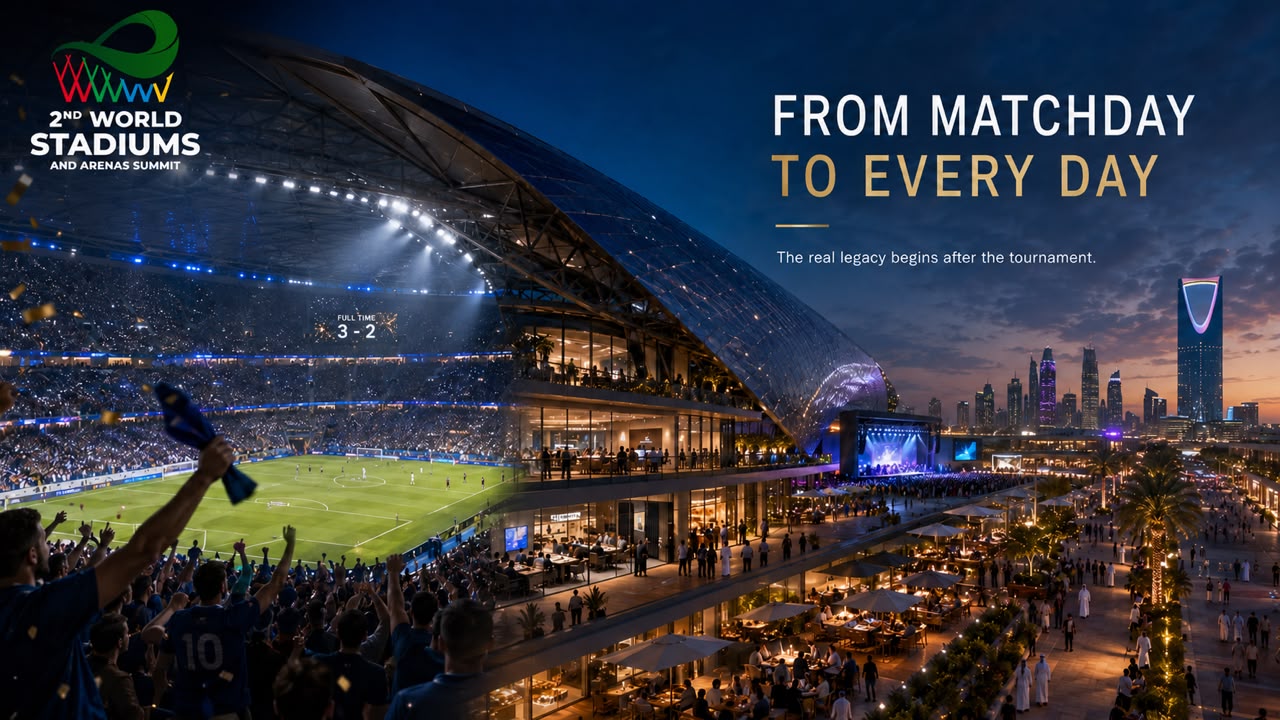
Beyond the Final Whistle: The Real Legacy of World Cup Stadiums Begins After the Tournament

Manal Saleh
Riyadh, Saudi
Arabia – August 26, 2026: Legacy
isn't created by hosting the World Cup. It's created afterwards. The future of
World Cup stadiums is increasingly being shaped by what happens after the final
whistle. From Qatar's planned redistribution of approximately 170,000
stadium seats to the 2026 FIFA World Cup's use of 16 existing venues, host
nations are rethinking how stadiums can remain active, adaptable, and
commercially viable long after the trophy is lifted. For the World Stadiums
& Arenas Summit, the conversation around stadium legacy is becoming one of
the defining priorities for the future of global sports infrastructure.
While World Cup venues
are built for football's biggest moments, their long-term success depends on
what follows. Increasingly, stadiums are evolving into year-round destinations
hosting domestic sport, concerts, exhibitions, conferences, tourism, retail,
hospitality and community programmes. Others have struggled to sustain regular
use, reinforcing the need for adaptable design and commercially sustainable
operating models.
The long-term future
of major tournament venues will be a key focus at the World Stadiums &
Arenas Summit, taking place on 14–15 October 2026 at Hilton Riyadh Hotel &
Residences. The programme will bring together stadium developers, operators, architects,
policymakers and commercial leaders to examine how venues can remain active,
adaptable and financially sustainable beyond major sporting events.
Dedicated discussions,
including ‘Stadium Operations & Post-Event Lifecycle’ and ‘Monetizing
Stadium Assets: From Sport to Year-Round Commercial Use’, will examine the
practical challenges of maintaining venue performance after tournaments. The
sessions will address year-round programming, naming rights, retail,
hospitality, sponsorship revenue and the long-term operational strategies
required to keep stadiums commercially and socially relevant.
Recent examples
illustrate this shift. Qatar demonstrates one model as it has planned to remove
and donate approximately 170,000 seats from six FIFA World Cup Qatar
2022™ stadiums, while seven of its eight tournament venues were reused for the
AFC Asian Cup in early 2024. In contrast, research into Brazil's 2014 FIFA
World Cup legacy found that only four of its 12 stadiums exceeded the
international benchmark for post-event utilisation, while South Africa's
Mbombela Stadium recorded a utilisation rate of just 9.8%. Meanwhile,
the 2026 FIFA World Cup was staged across 16 existing venues in Canada,
Mexico and the United States, signaling a growing emphasis on adapting existing
infrastructure rather than constructing new permanent stadiums.
"Having worked on stadiums across the world, one consistent
lesson is that the best venues are designed with operations in mind from day
one. Early collaboration between owners, operators, designers and engineers is
essential to creating places that remain successful, resilient and commercially
relevant long after the first event." ," said Rob
May, Partner – Burro Happold
Legacy also extends
beyond physical infrastructure. Under FIFA's "clean venue" policy,
stadiums with commercial naming rights temporarily adopt tournament-specific
names before returning to their original identities once the competition
concludes. During the 2026 FIFA World Cup, for example, Gillette Stadium will
become Boston Stadium and Levi's Stadium will operate as San Francisco Bay Area
Stadium, highlighting how tournament branding may be temporary, but a venue's
long-term commercial success is not.
As Saudi
Arabia prepares to host the AFC Asian Cup 2027 and FIFA World Cup 2034, legacy
planning, venue adaptability and long-term commercial sustainability are
expected to take centre stage at the World Stadiums & Arenas Summit.
Bringing together developers, architects, venue operators, investors and
policymakers, World Stadiums & Arenas Summit will explore how stadiums can
continue generating economic, social and community value long after the final
whistle.
XX
ENDS XX
مواضيع ذات صلة
Lenovo Appoints Dr. Rabeah Alzaidy to Lead Research & Development Initiatives in Saudi Arabia
منذ 33 دقيقة . News
.jpeg)
HONOR Is the Only Smartphone Brand to Grow in the Middle East in H1 2026 as the Market Declines
منذ 48 دقيقة . News
Beyond the Final Whistle: The Real Legacy of World Cup Stadiums Begins After the Tournament
منذ ساعة . News
FileCloud Expands Riyadh RHQ, Deepens PDPL and Data Sovereignty Capabilities for Saudi Organizations
منذ ساعة . News
Veeam Showcases Trusted Data Resilience for the AI Era at LEAP 2026, Reinforcing Commitment to Saudi Arabia
منذ ساعتين . News

Microsoft and HUMAIN announce long-term strategic collaboration to enable AI transformation in Saudi Arabia and beyond
منذ ساعتين . News
VCPEA Membership Surpasses SAR 100 Billion in Assets Under Management as Association Expands Support for Investment Ecosystem
منذ ساعتين . News

‘Warranty and care’ Menu Simplifies Device Care for New Foldables
منذ 3 ساعات . News
How to Stay Hydrated on Every Run With Galaxy Watch Ultra2
منذ 7 ساعات . News