Samsung Reimagines the Future of Design at CES 2026, Guiding Technology for Humanity

Manal Saleh
The concluding session of Samsung’s CES 2026 Tech
Forum series highlighted the human side of technology with leading designers
LAS
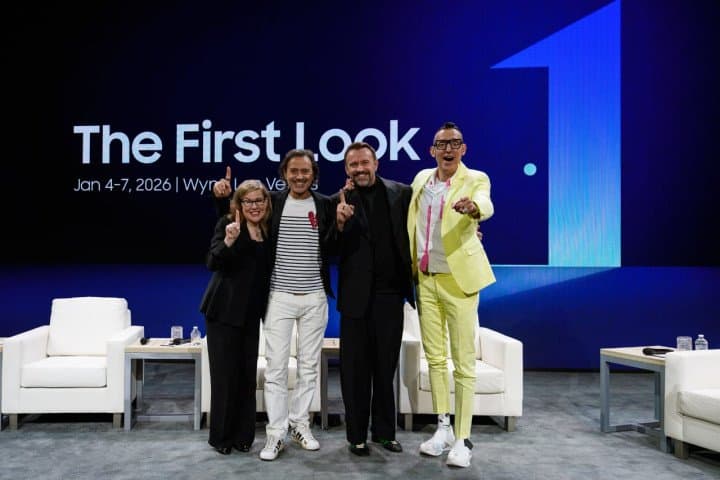
VEGAS — Jan. 8, 2026 — Samsung Electronics, Co., Ltd. today held the
final session in its CES 2026 Tech Forum series, “The Human Side of Tech:
Designing a Future Worth Living,” at Samsung’s The First Look space at The Wynn
Las Vegas. The panel, moderated by Debbie Millman, host of “Design Matters,”
featured Samsung Chief Design Officer Mauro Porcini and industry-leading
designers Karim Rashid and Fabio Novembre.
With minimalism
having defined the visual language of the tech industry for the past two
decades, this panel of designers convened by Samsung asked: What comes next? Together, the panelists explored how
warmer, more expressive and emotionally resonant technology can shape
meaningful experiences in today’s AI era, while also charting a path forward
for the industry.
The session covered a shared view
on the purpose of design as fundamentally people-first. “In recent years, design
in tech has been somewhat uniform,” said moderator Debbie Millman. “Compared to
other industries, the uniformity in the world of tech is an anomaly. So what if
we were to extend technology beyond specifications and functionality?”
Samsung is currently addressing
this question by introducing meaning beyond products by focusing on how
technology fits into people’s lives, experiences and needs. The panelists
discussed the growing importance of this mindset in the current landscape in
which traditional barriers to entry such as access to tools, scale and
technical capability continuing to diminish.
The Human Side of Tech
The discussion highlighted
technology’s role in making intention, care and humanity visible in everyday
life. Panelists noted that technology should help people recognize the
thoughtfulness embedded in the products they invite into their homes and
routines.
In this
context, Samsung Chief Design Officer Mauro Porcini shared Samsung’s design
purpose: to enrich the quality of people’s lives through meaningful technology
designed for humanity. He outlined the company’s commitment to help people live
longer, live better, live louder and live on through advanced technologies that
support wellbeing, creativity and self-expression.
Panelist Karim
Rashid added to this sentiment, saying, “When we think about physical things in
our world, we think not only about diversity of choice but also the fact that
we can develop strong connections to objects,” he said. “Through design, you
can end up with a very powerful, emotional connection with inanimate objects,
or even products.”
Designing for Human Values
The panel went on to explore how AI
can unlock new possibilities for expression when shaped by human values. Panelists
discussed a shared view that AI reaches its true potential when guided by Emotional
Intelligence and Human Imagination, not as a replacement for human creativity
but as a force that expands it.
CDO Porcini articulated this with
“AI × (EI + HI),” his approach to balancing Emotional Intelligence and Human
Imagination to bring meaning to innovation. While describing this philosophy,
CDO Porcini said, “When we design and develop, AI is amplified by Emotional
Intelligence and Human Imagination. “Then, when people use products, AI
amplifies Emotional Intelligence and Human Imagination.” He added, “Do not fear
technology. We are here to humanize it, guide it, and shape it.”
Through these insights, the
session reinforced the belief that technology should be humanized, guided and
shaped to serve people’s lives in increasingly new and meaningful ways.
Expressive Design Drives More Meaningful Experiences
The discussion
reinforced the importance of expressive design in bringing human-centered
purpose to life, creating experiences that reflect emotion, support
self-expression, invite connection and stimulate imagination.
“Happiness is the
aim of design,” said Fabio Novembre. “Our pursuit of happiness is through
design, making the impossible possible. I strongly believe in design, and that
it must move back to the center of the stage.”
Panelists noted that this reflects a shift from merely
designing objects to designing experiences where emotion, meaning and identity are
increasingly integral to how people relate to technology. This approach inspires
a new kind of expression, resulting in designs that range from subtle and
minimal to bold and imaginative — all meant to shape a future that isn’t just
worth living, but worth loving.
###
مواضيع ذات صلة

# Disty Holdings Is Reimagining Procurement with AI
منذ 7 ساعات . News
Nutanix Showcases "One Platform, One Experience" at LEAP Saudi Arabia 2026, Highlighting AI, Hybrid Multicloud and Cloud-Native Innovation
منذ 11 ساعة . News
.jpeg)
Garmin Opens First Riyadh Store and Launches fēnix 9 Series in Saudi Arabia
منذ يومين . News
Award-Winning Portuguese Chef Ana Magalhães Leads the Culinary Vision at Tabrah, Nujuma, a Ritz-Carlton Reserve
منذ يومين . News
Saudi Wood Expo opens next week at Riyadh Front Exhibition & Conference Center, bringing wood solutions and international expertise from 30 countries
منذ يومين . News

Samsung Galaxy S26 FE: Delivering the Latest Flagship Experience, Focused on What Matters Most
منذ يومين . News
Logitech brings the future of AI-powered workplaces to LEAP 2026
منذ يومين . News
.jpeg)
IFS Brings Industrial AI From Experimentation to Execution at LEAP 2026
منذ يومين . News
webook.com Shares Success of its Global Scale with Esports World Cup Delivery in Paris
منذ يومين . News